Someone Please Explain This to Me

…preferably as though I was aged for the target market of the book.

I’ve said for some length of time that eBooks need to be approached as being a replacement (if they can be said to ‘replace’ anything) for Mass Market Paperback editions of titles. they fulfill the same approach as the Penguin or Pocket editions of any novel: get the words to the eye-bones of the readers as easily as possible. There’s no requirement for them to last forever, they’re not meant to be cherished, they aren’t supposed to survive thousands of readings un-molested. They’re meant to be read, possibly re-read, and that’s about it really.

So, based on that, eBooks are the same, except they’re able to withstand multiple readings. None the less, however, they present the words in the simplest and plainest format for the express purpose of getting words to the eye-bones of the readers.

Thus, can someone please explain why this MMP costs TWELVE dollars:

“I Shall Wear Midnight” (Discworld Novel 38), by Terry Pratchett {paperback}

“I Shall Wear Midnight” (Discworld Novel 38), by Terry Pratchett {paperback}

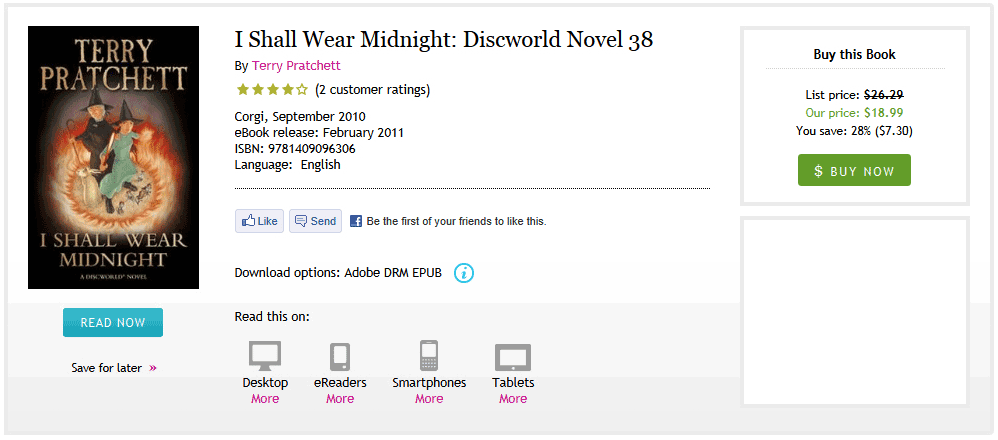
…yet the eBook below costs NINETEEN dollars:

“I Shall Wear Midnight” (Discworld Novel 38), by Terry Pratchett {electronic book}

“I Shall Wear Midnight” (Discworld Novel 38), by Terry Pratchett {electronic book}

…which is actually 50¢ more than the Hardcover edition of the work in the listing above it?

Don’t blame the un-identified retailers, they’re working with the Recommended Retail Price set by the publishers, which in this case is Transworld and Corgi, who seem to be bound and determined to ensure no eBook is ever purchased by any individual in the history of man.

Authors: talk to the houses who publish your work and insist they no longer ignore the way their are slicing their own throats. Electronic bindings are not some sort of luxury, especially as one has already bought some fancy electronic goo-gaw to read the books on in the first place. They can make money through volume sold just as easily as if they locate the handful of people in the marketplace daft or rich enough to pay top dollar for the option of carrying less paper.

‘Lorem Ipsum Dolor’ Just Got Yummier

Who needs boring old ‘placeholder text’ that’s doggerel Latin based on an 18th century manuscript when you can have ‘placeholder text’ that includes bacon? No really: HEAD HERE and you’ll get 5 paragraphs of “all-meat” text to paste into your layout for whatever design purpose you have. Here’s a sample of what that means:

Magna eiusmod ex, bresaola ad brisket meatloaf pancetta cillum. Jowl beef ribs swine jerky t-bone. Esse sirloin excepteur pork chop id in, bacon short ribs pig rump strip steak. Laboris shoulder reprehenderit excepteur, t-bone meatball est sed pork belly beef ribs ullamco turkey sirloin boudin. Jowl strip steak cow, ground round ball tip pork chop ea beef. Andouille pork pastrami, voluptate meatloaf sirloin jowl ground round id pancetta pork chop ullamco. Short loin consequat aliquip, sirloin consectetur quis officia pariatur salami cow flank commodo adipisicing do.

Head to the bottom of that page and you can specify a different number of paragraphs, as well as whether you want some filler included with your yummy meat, or if you want to start with the words ‘Bacon ipsum dolor sit amet…’ and then carry on with meat or a meat mixture. Yes, anything goes better with Bacon!!™

How to Pitch Your Thing to the Media: the AUDIO

So, finally, I have completed the editing of the audio for last month’s event with Stephen Quinn: How to Pitch Your Thing to the Media. Profuse thanks again to Mr. Quinn for his amazing generosity and enthusiasm throughout the entire organizing and carrying-out of the event.

Due to a few limitations that WordPress.com has for blogs hosted on their servers, the file is being stored over on the Atomic Fez Publishing web-site, in its own little Shebeen-dedicated folder. Thus, the MP3 ends up being declared an “outside source” by some anti-virus programmes and ad-block-based browser plug-ins. Should you get some sort of “hey! whattya doing! this could be bad!” warnings when you click the link below, reassure your software or browser that all is well, and to let you do what you want to.

Instead of clicking the little [PLAY] button immediately below and not moving for awhile, some of you might want to [right click] the words in the link, and select something like “Save link as…” or “Save target as…”, and thus download the file to listen to on your iPod or in the car, or wherever you listen to sound files that run 85 minutes in length.

How Not to Get the Media’s Attention

How Not to Get the Media’s Attention

How to Pitch Your Thing to the Media

Yes, that’s right, the file is nearly one hour-and-a-half long. I tried to trim out as much irrelevant material as possible — especially my prattling nonsense — but the problem is that Stephen Quinn is so gosh-darned informative and entertaining, that this is the shortest I could make it without taking forever to provide the audio. Hopefully Mr. Quinn will be amenable to returning in the near future so that we can hear more specifically on the topic of “journalism in the new millennium”, now that we’re in the post News of the World reality that he had the fortune of investigating whilst filling in at As it Happens this past fortnight.

The media package Mr. Quinn mentions at the 15 minute mark is the one you see in the photo above. An astonishingly odd piece of promotional material, even without the context that he places it within as part of his talk. Click the image for “biggification”.

The material Mr. Quinn plays is from Ira Basen’s six-part series “Spin Cycles”, which was twice run as part of CBC Radio1’s The Sunday Edition in 2007. You can learn more about that series — as well as access all six highly informative instalments — at this link RIGHT HERE.

I look forward to repeating the success of this event September 19th, upstairs at the Revel Room (on Abbott, between West Cordova and Trounce Alley).

Patience, Grasshopper

I’m still working on the audio track from last week’s event with Stephen Quinn. Originally running one hour and forty minutes, I’m trying to get it down to something more reasonable, as well as remove any un-necessary nattering on my part. the end result ought to be nothing but informative yummy goodness about how to make your information appeal to the ever-cynical, un-caring, heartless bastards of the media.

In the meantime (and partly because none of the media seems to give a damn about my exciting news), have a look OVER HERE about how Atomic Fez Publishing has been short-listed for Best Small Press by the British Fantasy Society’s awards.

Is Journalism Dead? Did the Bean-Counters Kill It?

This evening’s event with Stephen Quinn causes me to think about a book read some time ago Flat Earth News, by Nick Davies.

While Mr. Quinn is not a newspaper man, he is — first and foremost — a journalist. The book by Mr. Davies is about journalism, and the dearth of it in the papers found principally in London, but not exclusively so. Being a regular writer for The Guardian, his expertise lies in the output of Fleet Street rather than elsewhere, and thus he devotes much of his book to the state of British journalism in its newspapers as well as the BBC News web-site. It’s a fascinating read and highly recommended for people who think.

First, however, let’s have one thing clear from the outset: this is not about how some minority group or secret committee is controlling the world and / or the media. While there may be decisions made about things by groups we know nothing about (that’s why they’re ‘secret groups’ after all), it’s all too easy to shuffle off one’s responsibility for not doing anything to change things by blaming an anonymous ‘powerful individuals’. Here’s an H.L. Menken quote included in the book (p. 395) which goes some way to explain how this sort of thinking can be rubbish:

…the central belief of every moron is that he is the victim of a mysterious conspiracy against his rights and true deserts … [He] ascribes all his failures to get on in the world, all of his congenital incapacity damfoolishness, to the machinations of werewolves assembled in Wall Street or some other such den of infamy.

This book is specifically about how there are few, if any, people in control of the media. While many reporters and editors find all too frequently that they aren’t able to do the fact-checking they wish to — and are frustrated at the situation’s stasis — they aren’t the cause of it through lack of initiative; they simply haven’t the time. According to the staggeringly persuasive argument of author Nick Davies, the newspapers of the UK are essentially now all owned by people who have little interest in publishing newspapers containing journalism. What these individuals are principally concerned with is simply ‘selling copies of the paper each and every day, and the more the better.’ This quantity over quality approach is why they are termed “the Grocers” by Mr. Davies.

Cover art of “Flat Earth News” by Nick Davies

Cover art of “Flat Earth News” by Nick Davies

Certainly, any business must be operated with an eye to profit v. loss. However, there is so much an avoidance of idealism towards the media’s content, that the readers are being under-served to the point of unconscionable delivery of falsity on the part of the various persons responsible for the media outlets’ content.

While the book focuses much of its time upon the newspapers of London — including entire chapters each devoted to the Sunday Times, the Observer, and both the Daily and Sunday Mail newspapers–the problems and trends can all be recognized as being world-wide in scope. The newspapers of North America are, thankfully, prevented from out-right lying about individuals in print, owing to a reversal of the onus of proof in legal arguments here, when compared to the UK. That said, the habit of reporting quickly and loudly, then correcting slowly and quietly, is one which no legal or regulatory procedure can effectively prevent.

The other worrisome trend is the one first identified in the book: things being simply repeated from the texts of Media Releases without any effort to confirm that there is any validity within them, or even if they contain amplified — or ‘sexed up’, to use the UK Government’s term about the Iraqi WMD reports — versions of the truth which is then responsible for a snowball effect of panic about the subject in question; which then is fed-back into (EG: Iranian Elections get dropped to cover Michael Jackson’s death) or someone is able to stop the thing by explaining that it’s simply not true in the slightest and we can all relax now (EG: the nullification of the principle of habeas corpus in the USA is only applied to the cases of those naughty terrorists).

The fact that this book doesn’t cover is the recent development of newspapers closing due to financial decisions by their owners, despite any budget restraints they may have imposed prior to the shut-down. It would be fascinating to know what Mr. Davies’ views of the ‘new media platform’ might do to return journalists to the forefront of the delivery of facts. He suggests late in the book that an over-haul of newspapers is required, with the probable method of delivery being some sort of display screen.

Read this book, not to begin seeing some Secret Star-Chamber Cabal controlling the World’s fate, but in order to see that there is an ordinary group of men frantically pulling levers behind the curtain so as to continue making the Great Oz of the Media just as impressive and seemingly required as ever before.

Flat Earth News: An Award-Winning Reporter Exposes Falsehood, Distortion and Propaganda in the Global Media by Nick Davies; PP 420 (including index), ISBN: 978-0-099512-6-84; 2nd Edition published in 2009 by Vintage, an imprint of Random House, London, SW1V